← Home · Geophysics

Seismic Tomography for Foundation Engineering in Winnipeg

Together, we solve the challenges of tomorrow.

LEARN MORE →

Here in Winnipeg, the subsurface tells a story that boreholes alone cannot fully capture. The city sits on thick glaciolacustrine clays deposited by glacial Lake Agassiz, and what lies beneath that—the limestone bedrock of the Red River Formation—drops unpredictably. We have worked on sites in St. James where bedrock shows up at 8 meters, then vanishes to 30 meters just two lots away. That is exactly where seismic tomography earns its place. A single seismic refraction line can map that bedrock trough before the excavator arrives, giving the structural engineer a continuous profile instead of interpolating between scattered boreholes. For deeper targets or urban noise environments, we often combine methods with MASW surveys to extract Vs profiles for site classification under NBCC 2020.

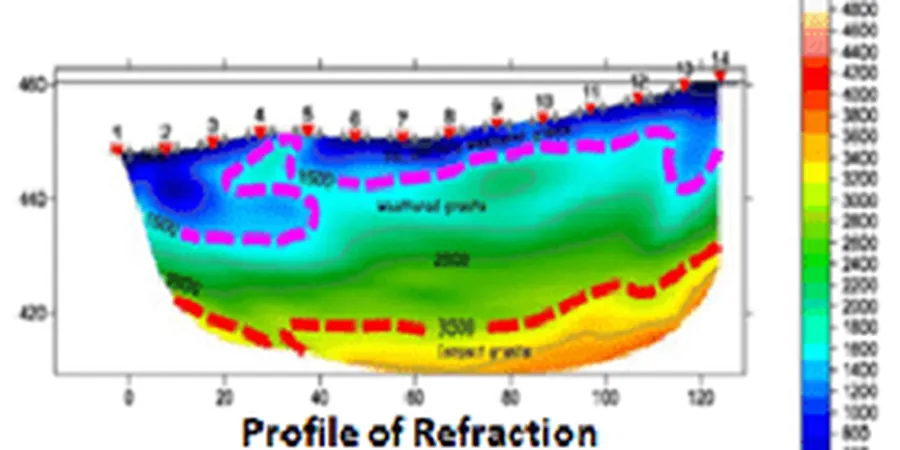
Seismic tomography converts travel-time curves into a continuous subsurface image, eliminating the blind spots between boreholes on Winnipeg's erratic bedrock surface.

Methodology and scope

The contrast between the silty clays and the underlying carbonate bedrock generates a sharp seismic impedance boundary, which makes Winnipeg an ideal candidate for refraction tomography. In neighborhoods like River Heights, where the clay is relatively shallow over limestone, P-wave velocities jump from 1,600 m/s to over 3,500 m/s at the contact. But in Transcona, where the deposit thickens and transitional till layers appear, the velocity gradient is gradual and requires careful first-break picking. Our field crew uses 24- to 48-channel seismographs with vertical geophones at 2- to 5-meter spacing, depending on target depth. The data processing workflow follows ASTM D5777-18 guidelines, and we run iterative inversion with damping constraints to resolve both the overburden stratigraphy and the top-of-rock topography. When the site geometry permits, we also acquire a parallel test pit to ground-truth the seismic interpretation at one control point, verifying the velocity-soil type correlation directly.
Seismic Tomography for Foundation Engineering in Winnipeg
Technical reference image — Winnipeg

Local considerations

NBCC 2020 requires Site Class determination based on shear-wave velocity in the upper 30 meters. Winnipeg's lacustrine clays frequently fall into Site Class D or E, which amplifies spectral acceleration and increases seismic design loads on structures. Missing a buried bedrock valley—a feature documented in the regional Quaternary geology literature—means the foundation design assumes uniform clay when, in reality, a stiff rock high is present at shallow depth. Differential settlement follows. We have seen this exact scenario on multi-family projects in the southwest quadrant, where a refraction tomography line detected a bedrock ridge that boreholes had missed by less than 4 meters laterally. The structural team adjusted the footing design before pouring concrete.

Need a geotechnical assessment?

Reply within 24h.

Email: contact@geotechnicalengineering.vip

Technical parameters

ParameterTypical value
Typical P-wave velocity (Lake Agassiz clay)1,400 – 1,800 m/s
Typical P-wave velocity (glacial till)2,000 – 2,600 m/s
Typical P-wave velocity (Red River limestone)3,200 – 4,500 m/s
Maximum depth of investigation (24-ch, 5 m spacing)30 – 40 m
Standard geophone spacing2 m, 3 m, or 5 m
Seismic source (urban sites)8 kg sledgehammer on steel plate
Applicable ASTM standardASTM D5777-18
Inversion methodTomographic (iterative, damped least-squares)

Associated technical services

01

Refraction Microtremor (ReMi) + Tomography

Combined P-wave refraction and surface-wave processing using passive traffic noise to extract Vs profiles for NBCC Site Class, ideal for busy Winnipeg streets.

02

Crosshole Seismic Testing

Direct measurement of P- and S-wave velocities between cased boreholes for modulus derivation on critical infrastructure projects.

03

Downhole Seismic Surveys

Velocity profiling in a single borehole to calibrate surface geophysics and refine the soil-rock interface depth.

04

Rippability and Excavation Assessment

Seismic velocity-based rippability classification using Caterpillar D9/D10 charts to plan rock excavation in Winnipeg's limestone.

Applicable standards

NBCC 2020 (National Building Code of Canada), ASTM D5777-18 (Seismic Refraction for Subsurface Investigation), CSA A23.3 (Design of Concrete Structures – seismic), referenced for Site Class implications

Frequently asked questions

What depth can seismic tomography reach in Winnipeg clay?

With a 120-meter spread and sledgehammer source, we typically image 25 to 35 meters below grade. The depth limit depends on the clay thickness: the high-velocity limestone bedrock acts as a strong refractor, so the method works reliably until that interface is reached. For deeper targets beyond 40 meters, we recommend a downhole survey or a larger energy source.

How does seismic tomography compare to MASW for Site Class determination?

MASW directly measures shear-wave velocity (Vs), which is the parameter NBCC uses for Site Class (A through E). Refraction tomography gives us P-wave velocity (Vp). We often run both on the same spread: tomography maps the bedrock geometry, and MASW provides the Vs30 value. The two data sets together give a more complete geotechnical model than either alone.

What is the typical cost range for a seismic tomography survey in Winnipeg?

Seismic tomography surveys in Winnipeg generally range from CA$3,990 to CA$7,560 per line, depending on spread length, number of shots, site access conditions, and whether MASW is acquired simultaneously. Winter surveys can be more efficient on frozen ground, which sometimes reduces mobilization time.
Location and service area

We serve projects across Winnipeg and its metropolitan area.

View larger map