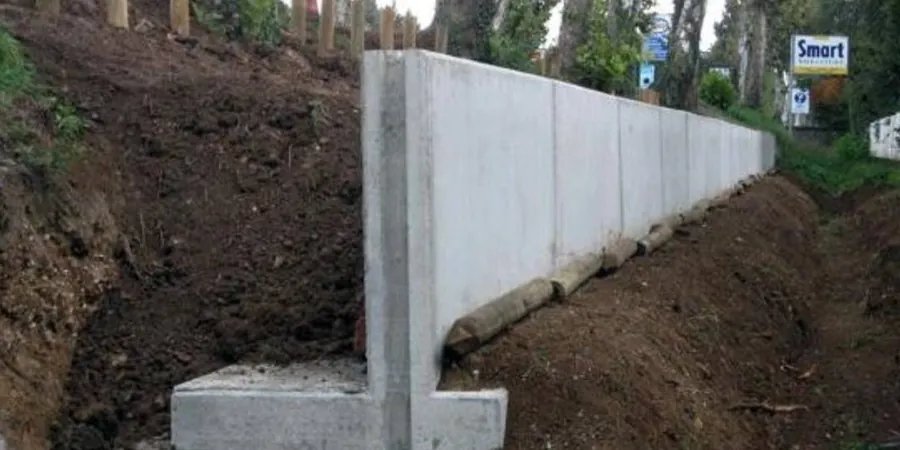
A developer planned a four-story residential building along Assiniboine Avenue, right near the riverbank. The geotechnical report showed soft, high-plasticity clays extending down almost 14 meters. That is not unusual in Winnipeg. Our team proposed a cantilever wall with a deep shear key and a drainage system designed for freeze-thaw cycles. In this city, where Lake Agassiz left behind thick lacustrine deposits, retaining wall design is never a copy-paste exercise. The combination of expansive clays, seasonal groundwater fluctuation, and frost penetration down to 2.4 meters demands a site-specific approach. We have supported projects from St. James to Transcona, adapting each wall to the local stratigraphy. Before finalizing the geometry, we often recommend a test pit investigation to confirm the fill thickness and check for buried organics, especially on lots that were redeveloped after the 1950 flood.
A retaining wall in Winnipeg must handle not just the soil pressure but also the relentless freeze-thaw cycles that can shift a poorly drained backfill in a single season.
Local considerations
The Manitoba Building Code, based on the NBCC, requires that retaining walls over 1.2 meters be designed by a qualified engineer, but the real risk in Winnipeg goes deeper than a height limit. The lacustrine clays here have a moderate to high swell potential, and when they saturate in spring, the lateral pressure against a wall can double the design assumption if drainage is inadequate. We have seen walls tilt after just two winters because the backfill was a silty native material instead of a free-draining granular fill. Frost jacking of the wall stem and ice lens formation behind the wall are real failure mechanisms in this climate. Our approach includes a solid drainage system with a perforated toe drain and a granular chimney drain, coupled with a waterproofing membrane on the retained side. We also specify a minimum embedment depth below the frost line to prevent base heave.
Frequently asked questions
How much does a retaining wall design cost in Winnipeg?
For a typical residential or light commercial retaining wall in Winnipeg, the engineering design fee ranges from CA$1.400 to CA$6.020, depending on the wall height, soil conditions, and the complexity of the drainage design.
Do I need a building permit for a retaining wall in Winnipeg?
Yes. The City of Winnipeg requires a building permit for any retaining wall over 1.2 meters in height, and the application must include sealed engineering drawings and a geotechnical report confirming the soil parameters used in the design.
What type of backfill should be used behind a retaining wall in Winnipeg?
We specify a clean, free-draining granular backfill, typically a well-graded sand and gravel mix, placed in compacted lifts behind the wall. Native silty clay from the excavation should never be used as backfill because it retains moisture and can develop ice lenses that increase lateral pressure during freeze-thaw cycles.
How long does the retaining wall design process take?
The design and drawing preparation usually take two to three weeks after the geotechnical site investigation is complete. For more complex walls or walls requiring third-party peer review, the timeline may extend by an additional week.