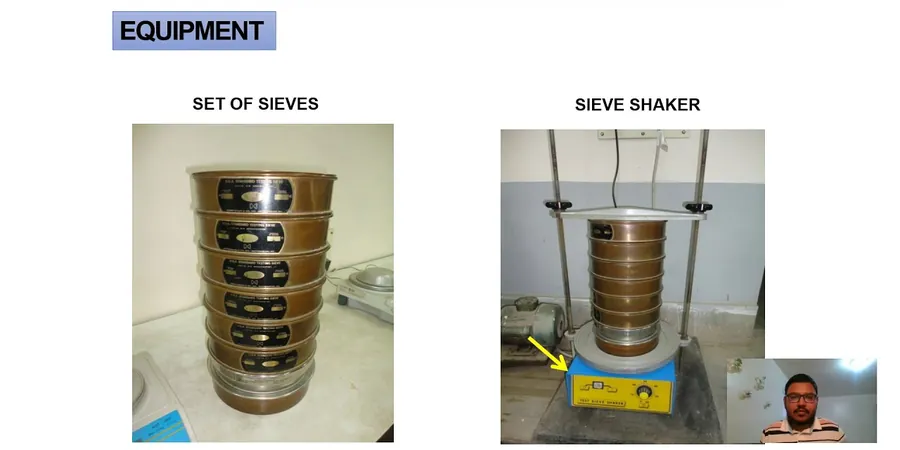
Winnipeg sits on the bed of ancient Lake Agassiz. A full 12 meters of fat lacustrine clay blankets much of the city. That clay dictates everything about your foundation. Standard sieve analysis misses the fines. You need the hydrometer too. Our lab runs the full ASTM D422/D6913 suite. We see silts from the Assiniboine floodplain every week. We see tills from the Birds Hill esker. Grain size distribution determines frost susceptibility. It controls drainage design. It predicts swelling potential. Miss the clay fraction and your retaining wall fails. It's that simple. For deep foundations in the clay belt, we often pair grain size with liquefaction screening when silts are present below the water table.
If your grain size curve stops at the No. 200 sieve in Winnipeg clay, you just ignored the most reactive 40% of your soil.
Methodology and scope
CSA A23.3 references ASTM D422 for concrete aggregate gradation. But we go further. Our Winnipeg lab runs sieve stacks from 75 mm down to 75 microns. Then the hydrometer takes over. We measure specific gravity per ASTM D854. Temperature correction is critical here. The lab sits at 238 meters elevation. Barometric pressure affects readings. We use sodium hexametaphosphate as dispersant. The hydrometer settles for 24 hours minimum. We log readings at 0.5, 1, 2, 4, 8, 15, 30, 60 minutes then 4 and 24 hours. This catches the 2-micron clay fraction. The old Winnipeg building code missed this. Now engineers demand it. A full curve from gravel to colloids tells you the soil's story. You see gradation gaps. You see uniform sands. You see gap-graded tills. Each one behaves differently under load. Each one drains differently. We flag anything outside the envelope immediately.
Frequently asked questions
How much sample do you need for a combined sieve and hydrometer test in Winnipeg clay?
For typical Lake Agassiz clay with high fines, 500 grams of air-dried material passing the No. 4 sieve is sufficient. If gravel is present, we need up to 5 kg total to run the coarse sieve stack properly. For aggregate gradation per CSA, 10 kg minimum for 20 mm nominal size.
What does a grain size analysis cost in Winnipeg?
A combined sieve and hydrometer test typically ranges from CA$130 to CA$270 depending on sample complexity. A wash-sieve only runs at the lower end. Full hydrometer with specific gravity is at the upper end. Volume discounts apply for 10+ samples.
How long does the hydrometer test take to run?
The sedimentation portion runs 24 hours minimum per ASTM D7928. We take readings at specified intervals over that period. Total lab turnaround including oven-drying, sieve analysis, and reporting is 3 business days. Rush service delivers in 24 hours for an additional fee.
Why does Winnipeg clay need a hydrometer instead of just sieves?
Winnipeg sits on glacial Lake Agassiz deposits. The clay fraction often exceeds 60% and includes swelling smectites. A sieve stack stops at 75 microns and misses everything finer. The hydrometer captures particles down to 1 micron. This clay fraction controls frost heave potential, swelling pressure, and drainage behavior. Without it, your geotechnical design is guessing.