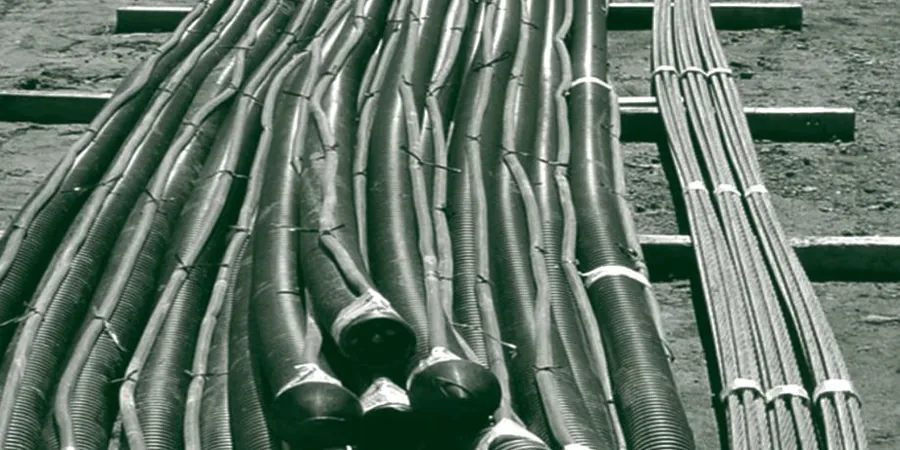
A 22-story tower at Portage and Main needed 18 m of excavation right next to an operational underground concourse. The contractor couldn't brace internally without disrupting pedestrian flow. We designed a multi-level tied-back system using active anchors socketed into the dense glacial till below the lakebed clays. That's the reality of building in Winnipeg—you deal with high-plasticity lacustrine deposits, hydrostatic pressure, and freeze-thaw down to 2.4 m. Anchor design here isn't plug-and-play. It requires locked-in bond stresses verified against the actual undrained shear strength profile. Before committing to a shoring contractor, the CPT testing crew can push right up to the excavation line to get continuous tip resistance and sleeve friction, giving us the stratigraphy we need to size the unbonded length correctly.
A properly locked-off anchor in Winnipeg's Lake Agassiz clay shouldn't creep more than 2 mm in the last 10 minutes of a 60-minute hold.
Frequently asked questions
What is the difference between an active and a passive anchor?
An active anchor is pre-stressed to a design lock-off load immediately after installation, actively applying force to the retaining structure. A passive anchor, like a soil nail, only develops tension as the soil mass deforms around it. In Winnipeg excavations deeper than 6 m, we typically specify active tiebacks because the soft clay needs immediate lateral restraint to keep movements under 25 mm.
How deep can you install anchors in Winnipeg's geology?
Anchor boreholes typically extend 15 to 35 m horizontally, depending on the depth to competent glacial till or limestone bedrock. The bonded section must socket at least 3 m into till with SPT N-values above 25 or into sound limestone. Deeper installations are feasible but require cased drilling through any artesian sand seams.
What is the typical cost range for anchor design and testing in Winnipeg?
Anchor design and testing packages in Winnipeg generally fall between CA$1,640 and CA$4,450, depending on the number of anchor rows, required test frequency, and corrosion protection class. A single proof test on one production anchor runs at the lower end; a full suite with multiple performance tests and long-term monitoring approaches the upper range.
How long does anchor installation and testing take?
A single production anchor can be drilled, grouted, and proof-tested within 2 to 3 days, assuming no drilling obstructions. Curing time for the grout before stressing is typically 5 to 7 days to reach the minimum 35 MPa compressive strength. A full excavation support cycle with multiple anchor rows may span 4 to 8 weeks.
Do you perform lift-off testing after lock-off?
Yes, we mandate lift-off testing on at least 5% of production anchors to confirm the residual load hasn't dropped below the design lock-off value. In Winnipeg's creeping clays, this check is essential; if an anchor has lost more than 10% of its load, we re-stress and re-lock it immediately.