One of the more costly mistakes a geotechnical firm can make in Winnipeg is over-relying on conventional boreholes to map the subtle interbedding within the glacial Lake Agassiz deposits. The standard split-spoon recovery often misses thin silt seams and slickensided shear zones that control slope stability along the Red and Assiniboine riverbanks. We see this frequently when reviewing older site records where a uniform clay profile was assumed, only for a contractor to hit a pressurized groundwater lens at 11 meters that halts excavation for a week. The CPT test resolves this ambiguity because the cone reads tip resistance and pore pressure every 2 centimeters, flagging those drainable layers before they become a site emergency. For projects near the floodway or in the mature clay districts of St. Boniface, pairing this continuous log with a seismic cone clarifies how the shear-wave velocity transitions from the stiff upper crust into the softer plastic clay below.
Pore pressure dissipation curves in Winnipeg's varved clays give a consolidation coefficient that no laboratory oedometer test can match for spatial coverage.
Local considerations
The urban fabric of Winnipeg expanded rapidly after the 1950 flood, pushing residential subdivisions onto the heavy clay plains west of the Red River. Those neighborhoods, built before modern consolidation theory was routinely applied, now show differential settlement patterns that trace back to undetected sand partings in the clay sequence. A single borehole every 30 meters cannot reliably catch a discontinuous silt lens that acts as a drainage path, accelerating consolidation under a new structure while the adjacent footing remains in undrained conditions. The CPT fills this gap by recording a near-continuous pore pressure and tip resistance log. On a recent River Heights project, the cone data revealed a 40-centimeter silty layer at 8 meters that the borehole logs had completely missed; the design team adjusted the pile length by three meters to bypass the zone of potential negative skin friction. Winnipeg's clay is not uniform, and the cost of pretending it is shows up years later in cracked grade beams and tilted elevator shafts.
Frequently asked questions
How much does a CPT sounding cost in Winnipeg per meter?
For a standard CPTu sounding in the Winnipeg area with pore pressure measurement and one or two dissipation tests, the unit rate ranges from CA$210 to CA$360 per meter, depending on mobilization distance and whether seismic cone (SCPT) add-ons are required. A typical 20-meter push to till refusal falls within the CA$4,200 to CA$7,200 window before lab correlation testing.
Can the CPT distinguish between the different Lake Agassiz clay units?
Yes, the combination of tip resistance, sleeve friction ratio, and excess pore pressure response provides a soil behavior type classification based on the Robertson chart system. The stiff, desiccated upper brown clay yields high qc and low friction ratios, while the deeper grey plastic clay shows lower tip resistance with elevated pore pressure. The transition into the basal till is unmistakable — qc jumps sharply above 25 MPa.
What is the minimum site access required for a CPT truck in Winnipeg?
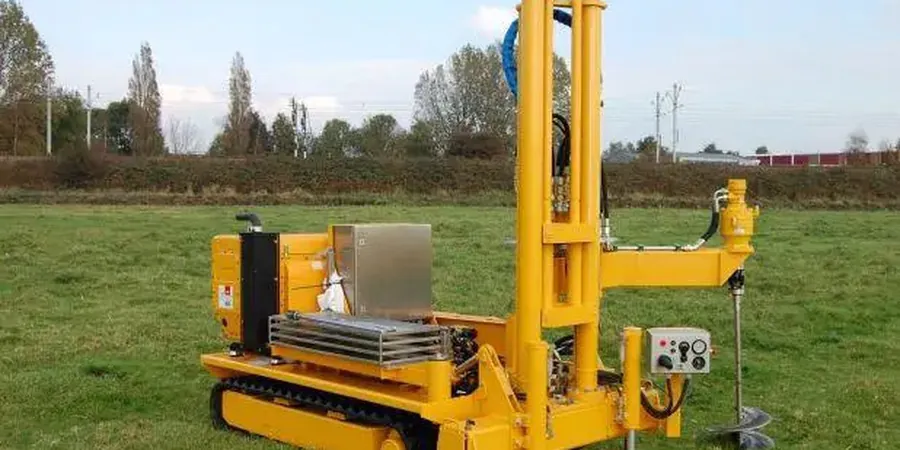
Our 20-tonne CPT truck needs a minimum vertical clearance of 3.8 meters and lateral access of roughly 3.0 meters. For confined sites in older neighborhoods like Wolseley or along narrow back lanes, we can switch to a tracked crawler unit that fits through a 1.2-meter gate opening, though winter operations on frozen clay require anchor augers to achieve reaction force.