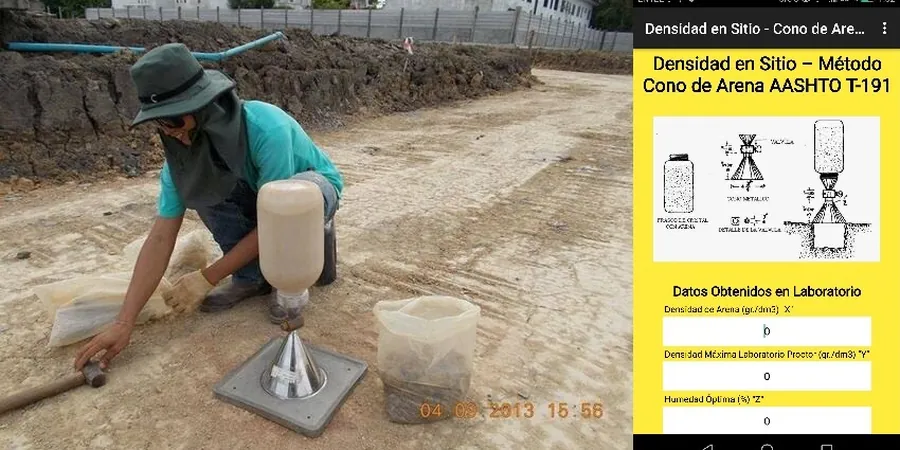
Compaction behaves differently depending on where you break ground in Winnipeg. A parking lot extension in St. James on well-drained deltaic sands will compact with few surprises, while a foundation pad in Transcona over the deep, fat Lake Agassiz clays demands a whole different level of scrutiny. The sand cone test gives us a direct, physical measurement of in-place density right at the lift surface, cutting through assumptions tied to lab curves. On sites where the water table sits within a metre of grade, we often pair in-situ permeability testing to understand how moisture is moving through the compacted layer before the next lift goes down. The goal is always the same: a density report the City's building inspector will accept without pushback, backed by ISO 17025-accredited lab verification of the sand gradation we use in the cone apparatus.
A sand cone test gives you a number you can defend — a physical weight of soil removed from a hole you can see and measure.
Frequently asked questions
How much does a sand cone density test cost on a typical Winnipeg residential lot?
For a standard single-family lot within the city, field density testing using the sand cone method runs between CA$130 and CA$210 per test, depending on how many lifts need verification in one visit and the travel distance from our lab. Most builders schedule four to six tests spread across the footing subgrade and backfill lifts.
Why use the sand cone instead of a nuclear gauge in Winnipeg?
Two reasons matter here. First, Winnipeg's high-plasticity clays can give nuclear gauges erratic readings because the hydrogen in bound water interferes with the neutron moderation signal. Second, sand cone equipment does not require a CNSC transport license, radiation safety training, or daily calibration checks — it works reliably even in frozen conditions with simple field tools.
What compaction standard does the City of Winnipeg require for residential footings?
The City typically references 98 percent of Standard Proctor maximum dry density (ASTM D698) for the top 600 mm below footings, with moisture content within 2 percent of optimum. Our reports show both the field dry density and the percentage achieved against the lab curve so the inspector can verify compliance at a glance.
Can you test compaction on gravelly fill with the sand cone method?
Yes, with a size caveat. ASTM D1556 method A works well for material with maximum particle size up to 50 mm. If the fill contains larger cobbles, we apply a rock correction by sieving the excavated material on a 19-mm sieve and adjusting the volume calculation, though the result becomes less precise and we flag it in the report.