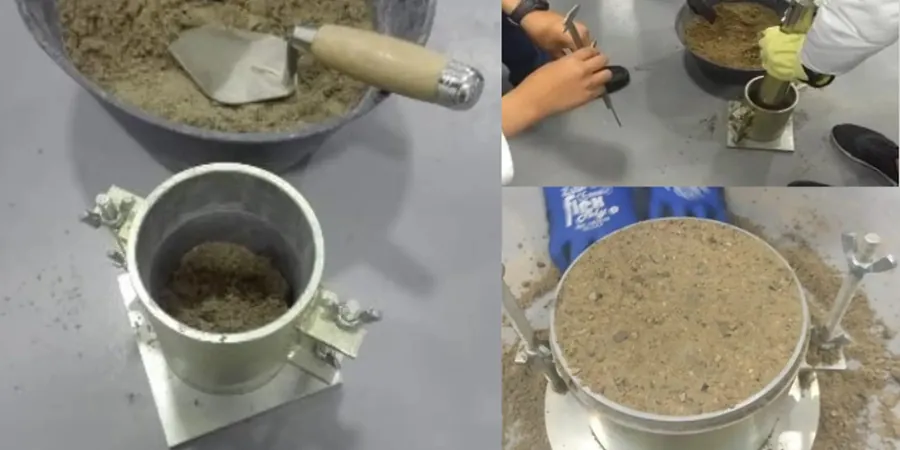
Winnipeg has a soil problem that shows up in August when the ground shrinks and again in April when it heaves. The culprit is almost always compaction, and more precisely, the moisture content at the time of placement. Our lab runs hundreds of Proctor tests each construction season for contractors working the Assiniboine Aquifer corridor and the new subdivisions pushing into the heavy clay belt west of Route 90. A grain-size analysis paired with the Proctor tells us whether the fines are silty enough to trap water or plastic enough to swell, and that single data point changes the target density by 10 pcf. The Manitoba Infrastructure standard spec calls for 98% of Modified Proctor under pavements, but hitting that number means knowing the exact optimum moisture content from a curve run on material from the same borrow pit, not one three concessions over. We run both Standard and Modified Proctor at the lab on Kenaston, usually with a 5-point curve on minus 4 material.
A Proctor curve run on the wrong borrow material is worse than no curve at all — it gives the roller operator a false target.
Local considerations
The risk profile for compaction acceptance changes completely between the east side of the Red River and the west side. East of the Red, in neighbourhoods like St. Boniface, the near-surface soils are often fine-grained alluvium with organic lenses that burn off in the oven, giving a falsely low optimum moisture content when tested without a loss-on-ignition correction. West of the river, the glacial till is denser but highly sensitive to small moisture changes within one percentage point of optimum. A contractor who over-compacts on the wet side of the curve in these silty tills creates a slick shear plane that fails the next spring during thaw. The most common compaction failure we see in Winnipeg is not under-compaction but over-compaction at moisture contents 2-3% above optimum on high-plasticity clay, where the remolded soil structure collapses under load. Running the Proctor curve on material that has been field-moisture conditioned, not oven-dried and re-wetted, produces a curve that better represents what the roller actually sees.
Frequently asked questions
What is the difference between Standard and Modified Proctor, and which one applies to my Winnipeg project?
Standard Proctor (ASTM D698) uses a 5.5 lb hammer dropped 12 inches, simulating older compaction equipment. Modified Proctor (ASTM D1557) uses a 10 lb hammer dropped 18 inches, replicating modern heavy rollers. Manitoba Infrastructure generally specifies Modified Proctor for pavement subgrades and Standard Proctor for building pads and landscaping fills. The choice depends on the project spec, not the soil type.
How much does a Proctor test cost in Winnipeg?
A single-point Proctor test typically ranges from CA$130 to CA$180, while a full 5-point curve for a borrow source characterization runs CA$200 to CA$260. The price depends on whether the material needs pre-drying, the number of points required, and whether we are running Standard or Modified effort.
How long does it take to get Proctor results for a Winnipeg construction site?
A standard 5-point curve takes 24 to 48 hours from material drop-off to the signed report. If the material is wet and requires oven-drying before pulverizing, add 24 hours. We do offer a 12-hour rush service for active earthworks when the contractor is waiting on a density acceptance number.
Why can't I just use a one-point Proctor instead of the full curve?
A one-point Proctor assumes the shape of the moisture-density relationship from a family of curves developed for that specific soil type. In Winnipeg, where glacial Lake Agassiz clays vary significantly in plasticity across short distances, that assumption often fails. A full curve is the only way to confirm the true optimum moisture content and avoid under-compaction or over-compaction on the wet side of optimum.