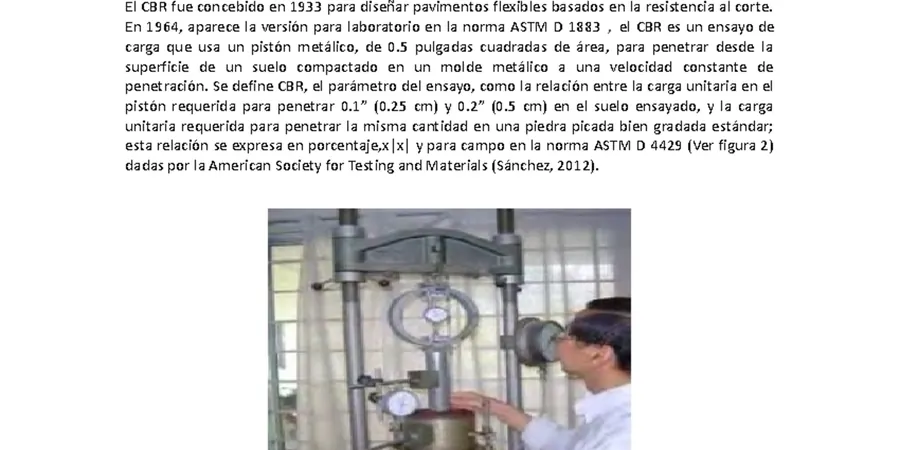
The CBR testing frame sits in our Winnipeg lab, its 4.54 kg cylindrical plunger poised to penetrate a compacted soil specimen at a precise 1.27 mm per minute. We run dozens of these tests each season, particularly when site investigation reveals the high-plasticity Lake Agassiz clays that define much of Winnipeg's subsurface. The laboratory California Bearing Ratio test, following ASTM D1883 and AASHTO T-193, measures the resistance of a remolded or undisturbed soil sample to penetration under controlled moisture and density conditions. For pavement engineers working on projects from the Perimeter Highway to new residential subdivisions in Waverley West, this value directly feeds into the structural thickness design of flexible pavements. We often pair this with a grain size analysis to understand the particle distribution driving the bearing response, and with Atterberg limits to quantify the plasticity characteristics of Winnipeg's fat clays.
A soaked CBR value on Winnipeg clay is not just a number for a report—it’s the difference between a pavement that lasts 5 years and one that fails after the first spring thaw.
Local considerations
Over the years, we’ve seen the same mistake repeated across Winnipeg’s construction season: a CBR sample taken in August during dry conditions, tested unsoaked, and producing an optimistic value of 12–18%. The pavement design proceeds, construction finishes in October, and by the following April the road shows distress—crocodile cracking, rutting, and edge failure. The culprit is almost always spring saturation reducing the in-situ CBR to a fraction of the design value. Our team insists on the soaked CBR protocol for any project where the water table is within 1.5 m of the subgrade, which covers most of Winnipeg given the city's flat topography and high groundwater in the Red River floodplain. We also recommend running in-situ permeability tests on site to understand drainage potential. Ignoring the effect of saturation on CBR in this region is not a calculated risk—it’s an engineering oversight with a predictable and costly outcome.
Applicable standards
ASTM D1883-21: Standard Test Method for California Bearing Ratio (CBR) of Laboratory-Compacted Soils, AASHTO T 193-22: Standard Method of Test for the California Bearing Ratio, ASTM D698-12(2021): Standard Test Methods for Laboratory Compaction Characteristics of Soil Using Standard Effort, ASTM D1557-12(2021): Standard Test Methods for Laboratory Compaction Characteristics of Soil Using Modified Effort, CSA A23.1/A23.2: Concrete Materials and Methods of Concrete Construction / Test Methods (for concrete pavement sections), City of Winnipeg Standard Construction Specifications — Division 31: Earthwork
Frequently asked questions
What is the typical turnaround time for a laboratory CBR test in Winnipeg?
A standard soaked CBR test requires a minimum of 4 days for the soaking period plus 1 day for compaction, penetration testing, and data reduction. Our typical reporting turnaround is 6 to 8 business days from sample receipt. Expedited service may be available for an additional fee depending on current laboratory workload.
How much does a CBR test cost in Winnipeg?
A single-point soaked CBR test according to ASTM D1883 typically ranges from CA$180 to CA$320, depending on whether it is a single-point or three-point determination and whether a companion Proctor compaction test is required. A full compaction control package (Proctor + CBR) generally falls in the higher end of that range.
Do you test undisturbed Shelby tube samples for CBR, or only remolded specimens?
We can test both. Remolded specimens are more common for pavement design because they represent the soil after construction compaction. However, we also perform CBR tests on undisturbed Shelby tube samples when the project requires an evaluation of in-situ strength without recompaction. The test standard is the same, but we note the sample preparation method in the report.
What CBR value does the City of Winnipeg require for residential street subgrades?
The City of Winnipeg typically requires a minimum soaked CBR of 3% to 6% for residential street subgrades, depending on the functional classification of the roadway. Granular base course and sub-base thickness are then designed accordingly. Our reports clearly indicate whether the tested material meets these specification thresholds.