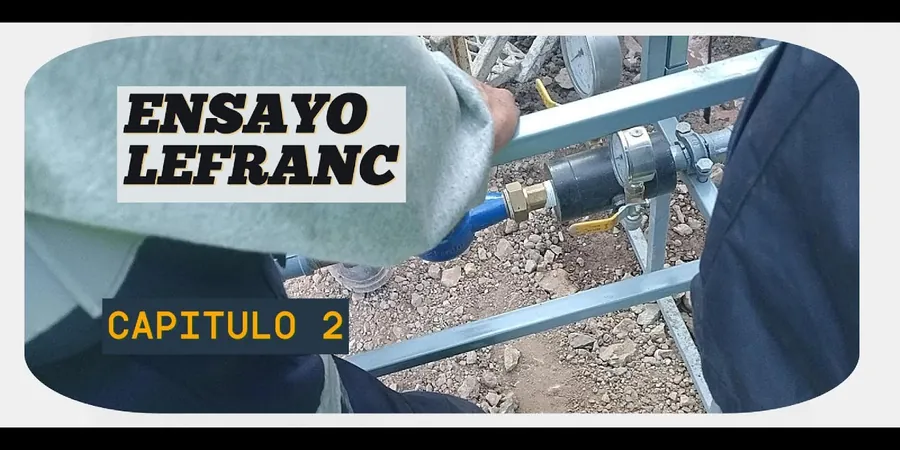
In a city built on the bed of a prehistoric lake, groundwater is never just an afterthought. Winnipeg's soil profile is dominated by the legacy of glacial Lake Agassiz: thick, plastic clays interbedded with silt lenses and underlain by carbonate bedrock. What we see time and again on sites from Transcona to Charleswood is that the actual field permeability rarely matches what a desktop study predicts. A test pit might reveal the stratigraphy, but it won't quantify how water moves through a fractured till or a sandy interlayer under a proposed basement. That's precisely where a field permeability test, whether a Lefranc in soil or a Lugeon in rock, becomes indispensable. The data we gather at depth informs dewatering plans, cutoff wall designs, and even the long-term durability of concrete in contact with local groundwater chemistry.
A single Lugeon test in fractured Winnipeg limestone reveals more about groundwater risk than a hundred grain-size curves from the overlying clay.
Local considerations
The contrast between two areas of the city illustrates the risk perfectly. In the Assiniboine River corridor, where alluvial sands and silts overlie the till, we routinely measure permeability values high enough to require wellpoint dewatering for any excavation deeper than three meters. Drive fifteen minutes east to the heavy clays of St. Boniface, and the Lefranc test often shows such low permeability that contractors assume they can dig dry—until they hit a sand lens at four meters and the trench collapses. This is the reality of building in a lacustrine plain: the soil memory of ancient shorelines and ice-rafted dropstones creates abrupt changes in drainage conditions. Ignoring these contrasts leads to flooded pits, unstable slopes, and foundation concrete that cures under hydraulic pressure instead of in controlled conditions.
Frequently asked questions
What is the typical cost of a Lugeon or Lefranc test in Winnipeg?
A single field permeability test in the Winnipeg area generally runs between CA$900 and CA$1,430, depending on the depth, number of pressure stages, and whether the borehole is already available or must be drilled specifically for the test. Mobilization and data reporting are included in that range.
When do I need a Lugeon test instead of a Lefranc test?
The Lugeon test is for rock, specifically the limestone and dolomite bedrock below the glacial drift in Winnipeg. If your project involves anchors socketed into bedrock, deep foundations bearing on limestone, or a tunnel in rock, you need the Lugeon. The Lefranc test is for the overburden—the clay, silt, and till—and is the right choice for basement dewatering analysis or cut-and-cover excavation planning.
How long does a typical field permeability test take on site?
A single Lugeon test with five pressure stages takes about 90 to 120 minutes once the packer is set. A Lefranc test in the clay till can take longer—sometimes two to three hours—because the low permeability means the water level recovers slowly. We always plan for at least half a day per test to allow for proper saturation and stabilization.
Can these tests tell me if my excavation will stay dry?
They provide the most reliable input for a dewatering assessment, but they are not a yes/no answer by themselves. The permeability value we measure, combined with the stratigraphy from the borehole log, lets your hydrogeologist calculate inflow rates and design a dewatering system. A series of tests across the site gives you the range of conditions to expect, which is far more useful than a single number.
Do you need a special borehole for the Lugeon test?
Yes, it must be a cored hole, typically HQ size, so the packer can seal against a smooth, stable rock wall. The borehole should be drilled with clean water, not drilling mud, to avoid clogging the fractures we are trying to test. We can coordinate the drilling and testing as a single package to ensure the hole preparation meets ASTM D6391 requirements.