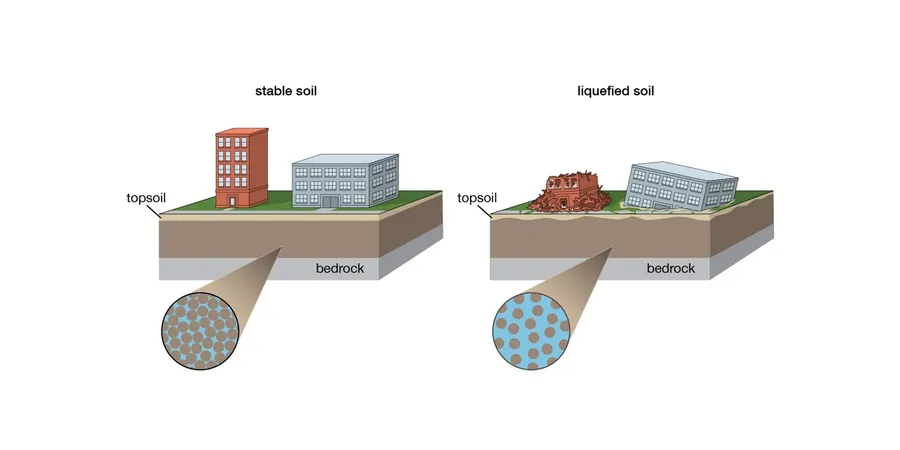
Ground conditions change dramatically as you move from the limestone bedrock uplands near St. James toward the deep alluvial clays of Transcona. We have seen two sites less than three kilometers apart produce completely different liquefaction screening outcomes simply because one sat on a thin sand lens within the Lake Agassiz sequence while the other was dominated by stiff glaciolacustrine clay. In Winnipeg, the challenge is rarely about finding loose sand at the surface; it is about identifying discontinuous saturated sand and silt seams trapped between thick cohesive layers, often at depths between 6 and 14 meters, where a routine borehole programme might miss them. Our approach pairs SPT drilling with targeted in-situ permeability testing to define drainage conditions that control excess pore pressure buildup during a seismic event.
A discontinuous sand seam at 10 meters depth can generate enough excess pore pressure to cause differential settlement that shows up in floor slabs two years after the earthquake—long after the shaking stopped.
Local considerations
The dominant soil profile across much of Winnipeg consists of 15 to 25 meters of glaciolacustrine Lake Agassiz deposits—rhythmically bedded silty clays and clayey silts—overlying till or limestone bedrock. The shallow water table, typically within 1.5 to 3.0 meters of ground surface in spring, keeps interbedded silt seams fully saturated year-round, which is precisely the condition that triggers liquefaction during long-duration, moderate-magnitude events originating from the Western Quebec Seismic Zone. While Winnipeg sits in a region of relatively low seismicity, the 2020 National Building Code assigns spectral accelerations that still require liquefaction screening for Importance Category 3 and 4 structures, particularly hospitals, emergency response facilities, and bridges over the Red and Assiniboine rivers. The consequence we worry about most is not bearing capacity failure but cumulative post-liquefaction settlement—thin sand layers compressing under load and causing differential movement that compromises pile-supported abutments and buried utilities.
Applicable standards
NBCC 2020 (National Building Code of Canada, seismic provisions), Youd-Idriss (2001) NCEER/NSF Workshop recommendations for liquefaction triggering, Idriss-Boulanger (2008) SPT-based liquefaction triggering procedures, ASTM D1586-18 (Standard Test Method for Standard Penetration Test), ASTM D6066-11 (Standard Practice for Determining the Normalized Penetration Resistance of Sands)
Frequently asked questions
Is Winnipeg seismically active enough to require liquefaction analysis?
Yes, under the right circumstances. NBCC 2020 assigns a design PGA of 0.042 g on Site Class C, which is modest by global standards, but the long-duration shaking possible from a Western Quebec Seismic Zone event means loose saturated silts can still accumulate excess pore pressure. For post-disaster buildings, schools, and critical infrastructure, the code triggers liquefaction screening, and we treat it as a required due-diligence step rather than an optional analysis.
Which soil types in Winnipeg are most susceptible to liquefaction?
The main concern is the interbedded silty sand and sandy silt seams within the Lake Agassiz sequence, particularly those with fines content below 35 percent and SPT N-values under 15 blows per foot. Clean sand is rare here; most of what we flag sits in the transitional zone where fines content correction becomes critical. We also look closely at recent alluvial and floodway fill deposits along the Red and Assiniboine rivers that were placed without compaction control.
Do you use CPT or SPT for liquefaction screening in Winnipeg?
We use both, but SPT dominates our Winnipeg investigations because the stiff glaciolacustrine clays that overlie most liquefiable seams make continuous CPT pushing difficult without exceeding refusal limits. When site conditions permit, we pair the two methods—CPT for its continuous stratigraphic profile and SPT for fines content sampling—to cross-check triggering curves and reduce uncertainty in the final CSR/CRR ratio.
How do you estimate settlement after liquefaction, and why does it matter?
We estimate post-liquefaction volumetric strain using the Ishihara-Yoshimine (1992) chart-based method or the Zhang et al. (2002) CPT-based procedure, correlating factor of safety against liquefaction to expected reconsolidation strain. Settlement matters because even 25 to 50 millimeters of differential movement can shear buried piping connections and create steps at grade beams, and that type of damage tends to be hidden until operational failures occur months after the seismic event.
What does a liquefaction analysis cost for a typical Winnipeg commercial project?
For a standard commercial site requiring SPT drilling, laboratory fines content testing, and a full liquefaction triggering report with LPI mapping, the analysis typically falls in the range of CA$3,840 to CA$5,100, depending on the number of boreholes and the depth of the granular interval being investigated. Sites with complex stratigraphy or those requiring CPT verification will fall toward the upper end of that range.