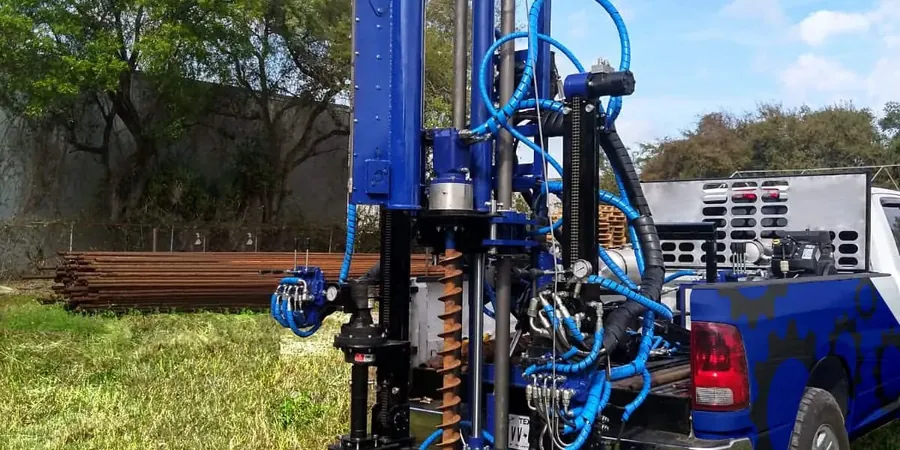
Winnipeg's growth from a fur trading post at The Forks into a modern prairie capital has always been shaped by what lies beneath: the deep, compressible clays of glacial Lake Agassiz. The Red River and Assiniboine floodplains deposited layers of silts and organic soils that challenge every foundation decision from St. James to Transcona. Standard Penetration Testing, or SPT, has been the go-to method here for decades—it gives us a straightforward, repeatable field measurement that ties directly into decades of local geotechnical practice. In neighborhoods like River Heights or new industrial parks near CentrePort, understanding N-values at depth makes the difference between a straightforward shallow footing and a costly deep foundation. The SPT data feeds directly into pile capacity calculations and liquefaction assessments under the National Building Code of Canada, and when paired with lab classification from grain size analysis, we build a soil profile that actually reflects what the driller saw coming up the split spoon.
In Winnipeg's Lake Agassiz clays, an uncorrected N-value of 4 at 12 meters isn't an anomaly—it's Tuesday. The engineering value is in knowing what that means for settlement.
Frequently asked questions
How much does an SPT borehole typically cost in Winnipeg?
For a standard SPT borehole in Winnipeg, you’re generally looking at a range between CA$790 and CA$1,110 per borehole, depending on depth, access conditions, and whether lab testing is bundled. Mobilization for a drill rig across the city—from Charleswood to East Kildonan—adds a line item, and deeper holes through the clay into till push toward the upper end of that range.
How deep do SPT boreholes usually go in Winnipeg?
Most SPT boreholes in Winnipeg extend between 15 and 25 meters, which is deep enough to penetrate the soft Lake Agassiz clay and reach the underlying glacial till or bedrock. For taller structures or where deep piles are being considered, we may go deeper, especially if the till is thin or if there’s a need to evaluate the limestone bedrock of the Red River Formation.
What seismic site class does Winnipeg typically fall into?
Much of Winnipeg falls into NBCC site class D or E, depending on the depth and stiffness of the lacustrine clay at the specific location. SPT testing provides the N-values and inferred shear wave velocities needed to assign the correct site class, which directly influences the seismic design forces a structural engineer must use.
Can SPT be used to check for liquefaction in Winnipeg soils?
Yes, liquefaction assessment is a standard output from SPT data when we encounter saturated, loose sandy layers—something that does occur in buried river channel deposits and alluvial sands beneath the clay in parts of the city. We apply the NCEER/Youd-Idriss procedure using corrected N₆₀ values to evaluate the factor of safety against liquefaction at the design earthquake magnitude.