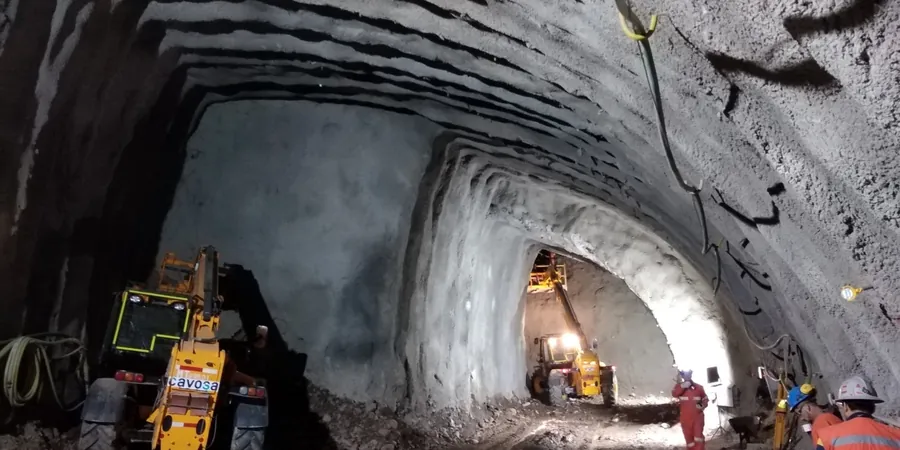
Winnipeg sits on up to 60 meters of glaciolacustrine clay left by Lake Agassiz. That is not a forgiving soil profile when you plan to open a tunnel. The Red River Valley's high-plasticity clays, artesian pressures, and seasonal groundwater swings demand more than a standard site investigation. We deliver laboratory and field data specifically for soft ground excavation: undrained shear strength, consolidation parameters, and pore pressure response. Our work follows ASTM standards and integrates with the geotechnical baseline reports your contractor needs. Before mobilizing a TBM or starting a sequential excavation, we often run a complementary CPT campaign to map stratigraphic boundaries continuously, which helps identify silt lenses that can cause face instabilities in the Lake Agassiz formation.
Winnipeg's Lake Agassiz clay can lose 70% of its undrained shear strength when remolded. Sensitivity values above 4 are common and demand a cautious excavation sequence.
Local considerations
A sewer tunnel project in St. Boniface, excavated with a roadheader through the grey clay unit, encountered a 1.5-meter-thick silt layer at 14 meters depth. The silt was not identified during the preliminary borehole program. Water inflow from that lens saturated the face, the clay softened rapidly, and the crown lost 400 mm of ground in under two hours. The contractor had to stop, fill the heading with low-strength grout, and redesign the support sequence. That delayed the drive by three weeks. The root cause was poor stratigraphic resolution between boreholes spaced 80 meters apart. We now insist on CPT soundings between conventional boreholes and continuous face mapping when working in Winnipeg's interbedded glaciolacustrine deposits. Silt seams are common here, and they are the number one cause of face instability in soft ground tunnels.
Applicable standards
ASTM D4767 (Consolidated Undrained Triaxial Compression Test for Cohesive Soils), ASTM D2435 (One-Dimensional Consolidation Properties of Soils), CSA S6:19 (Canadian Highway Bridge Design Code – Section 7: Foundations and Geotechnical Systems), NBCC 2020 (National Building Code of Canada – Part 4, Structural Design, Geotechnical Section), ASTM D5084 (Flexible Wall Permeability)
Frequently asked questions
What is the typical cost of a geotechnical analysis for a soft soil tunnel in Winnipeg?
Depending on the number of boreholes, depth of investigation, and laboratory testing required, a complete analysis for a soft ground tunnel project in Winnipeg typically ranges between CA$5,080 and CA$20,790. A small-diameter utility tunnel with limited access will be at the lower end, while a deep sewer or transit tunnel requiring multiple boreholes, CPT soundings, and a full triaxial consolidation program will approach the upper end.
How do you account for the artesian conditions in the Winnipeg area?
We measure pore pressure directly using sealed piezometers installed in the bedrock and in confined sand layers within the till. If artesian pressures are present, we include them in the baseline report and calculate the hydraulic gradient across the tunnel face. This data feeds into the contractor's EPB pressure calculations and ground treatment decisions.
What ASTM standard do you use for consolidation testing?
We perform incremental consolidation tests following ASTM D2435. For projects requiring higher accuracy on time rate of settlement, we can also run constant rate of strain (CRS) consolidation tests following ASTM D4186. Both methods give you the Cc and Cv values needed for tunnel crown settlement predictions.
Can you provide parameters for finite element modeling of the tunnel excavation?
Yes. We deliver effective stress strength parameters (c' and phi') from CIU triaxial tests with pore pressure measurement, small-strain stiffness from resonant column or bender element tests if required, and consolidation parameters for coupled analysis. All values are presented with upper-bound and lower-bound ranges suitable for PLAXIS or FLAC input.
How long does the laboratory testing program take?
A standard program for one tunnel alignment, including triaxial, consolidation, and index tests on Shelby tube samples, takes approximately 4 to 6 weeks. Consolidation tests on the high-plasticity Winnipeg clay require longer load increments due to the low permeability, so we never rush the schedule at the expense of data quality.