HomeIn-Situ Testing

In-Situ Testing in Winnipeg

Together, we solve the challenges of tomorrow.

LEARN MORE →

In-situ testing in Winnipeg provides direct measurement of soil properties without sample disturbance, critical given the region's extensive glaciolacustrine clays and silt deposits. Local geotechnical investigations must align with Canadian Foundation Engineering Manual principles and Manitoba Infrastructure standards to accurately characterize the sensitive, high-plasticity Lake Agassiz clays that dominate the area. Common field methods include the standard penetration test for stratigraphic profiling and the field density test (sand cone method) to verify compaction quality in accordance with ASTM D1556.

These tests are essential for foundation design in commercial and residential developments across the Red River Valley, where bearing capacity and settlement potential govern structural decisions. Roadway and utility trench backfill projects routinely demand sand cone density testing to confirm engineered fill meets specified relative compaction, while deep foundation assessments may require complementary methods to evaluate shaft resistance in glacial till. Accurate in-situ data ensures cost-effective designs tailored to Winnipeg's challenging subsurface conditions.

Available services

Field density test (sand cone method)

→ Ver detalle

A 22-story tower at Portage and Main needed 18 m of excavation right next to an operational underground concourse. The contractor couldn't brace internally without disrupting pedestrian flow. We designed a multi-level tied-back system using active anchors socketed into the dense glacial till below the lakebed clays. That's the reality of building in Winnipeg—you deal with high-plasticity lacustrine deposits, hydrostatic pressure, and freeze-thaw down to 2.4 m. Anchor design here isn't plug-and-play. It requires locked-in bond stresses verified against the actual undrained shear strength profile. Before committing to a shoring contractor, the CPT testing crew can push right up to the excavation line to get continuous tip resistance and sleeve friction, giving us the stratigraphy we need to size the unbonded length correctly.

A properly locked-off anchor in Winnipeg's Lake Agassiz clay shouldn't creep more than 2 mm in the last 10 minutes of a 60-minute hold.

Methodology and scope

Winnipeg sits on up to 18 m of soft, laminated silty clay overlying glacial till and limestone bedrock. The clay swells in spring, shrinks in late summer, and holds pore pressure that decays slowly after construction. These conditions define our anchor design approach. We specify double-corrosion protection per PTI DC35.1 for permanent anchors, even in temporary applications, because the soil resistivity here drops below 2,000 ohm-cm in many boreholes. Lock-off loads are calculated at 100% of the design load for active anchors and 70% for passive bars. Proof testing reaches 133% of the design load, held for 60 minutes per CSA A23.3 Annex D. The unbonded length extends at least 1.5 m beyond the failure wedge defined by the cut slope angle. In downtown Winnipeg excavations, where adjacent footings and utilities crowd the right-of-way, we often combine slope stability analysis with anchor pre-loading to limit lateral deformation to under 25 mm.
Active and Passive Anchor Design in Winnipeg Soils
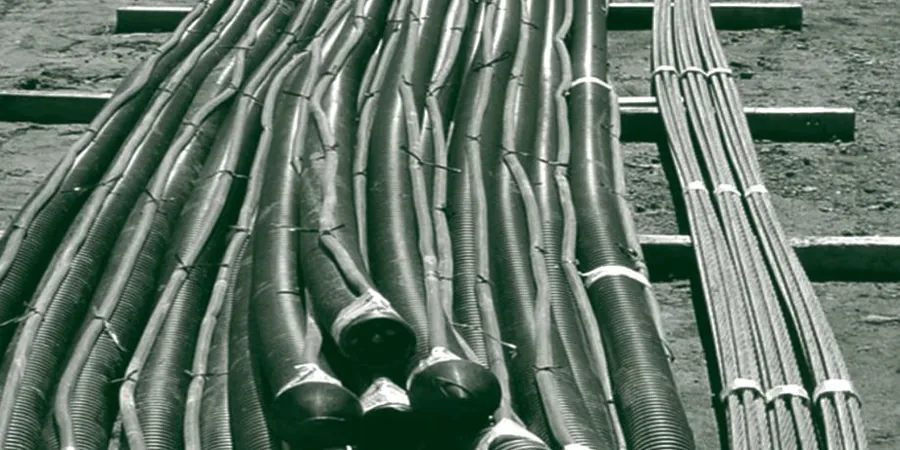
Technical reference image — Winnipeg

Local considerations

Winnipeg's urban core expanded rapidly after the 1950 floodway construction, but many pre-1970 buildings rest on shallow footings in desiccated clay crust. That crust is only 3 to 5 m thick. Excavate below it for a parkade or underground LRT station and you immediately expose the soft, normally consolidated clay beneath. Anchor creep becomes the dominant failure mode. We have seen lock-off loads drop 12% in 48 hours when the bonded zone was placed too close to a sand lens carrying artesian pressure. The city's groundwater table typically sits 1.5 to 2.5 m below grade, but perched water in silt seams can blow out drill holes if not cased properly. On sites near the Red or Assiniboine rivers, riverbank instability adds another variable. A single ungrouted tendon in a permanent anchor can corrode through in less than 15 years in these soils. That is why our team specifies full encapsulation grouting and mandates lift-off testing on 5% of production anchors post-lock-off.

Need a geotechnical assessment?

Reply within 24h.

Email: contact@geotechnicalengineering.vip

Technical parameters

ParameterTypical value
Design lifeTemporary (<2 yr) or Permanent (>2 yr) per PTI DC35.1
Bonded length (active)8–15 m in glacial till; minimum 3 m in bedrock
Unbonded length≥1.5 m past critical failure surface
Proof test load133% of design load, held 60 min (CSA A23.3 Annex D)
Lock-off load100% (active), 70% (passive) of design load
Corrosion protectionClass I or II per PTI; double-corrosion in resistivity <2,000 ohm-cm
Creep criterion<2 mm movement between 6 and 60 minutes at proof load
Grout strengthfc' ≥ 35 MPa at 7 days, neat cement w/c ≤ 0.45

Associated technical services

01

Active Anchor Design (Tiebacks)

Pre-stressed tendons for soldier pile and secant wall support. We size bonded length using the Littlejohn and Bruce (1977) empirical method, then validate with on-site pull-out tests in the actual till unit.

02

Passive Anchor Systems (Soil Nails)

Grouted bars installed in stages as excavation proceeds, working in tension to reinforce the soil mass. We use the FHWA GEC No. 7 approach for nail spacing and facing design in stiff-to-hard clay.

03

Proof and Performance Testing

Full CSA A23.3 Annex D-compliant load testing with calibrated hydraulic jacks, digital dial gauges, and automated data logging. We test to 133% of design load and measure creep over 60 minutes.

04

Corrosion Risk Assessment

Soil resistivity and pH/chloride/sulfate profiling per PTI DC35.1. We specify epoxy-coated strand or full-length sheathing when resistivity falls below 2,000 ohm-cm, common in Winnipeg's riverbank deposits.

Applicable standards

CSA A23.3-19 Annex D (Anchor testing), PTI DC35.1-14 (Recommendations for Prestressed Rock and Soil Anchors), ASTM A615/A615M-22 (Deformed bars), NBCC 2020 Part 4 (Excavation and foundations), ASTM D4435-13 (Rock bolt anchor pull test)

Frequently asked questions

What is the difference between an active and a passive anchor?

An active anchor is pre-stressed to a design lock-off load immediately after installation, actively applying force to the retaining structure. A passive anchor, like a soil nail, only develops tension as the soil mass deforms around it. In Winnipeg excavations deeper than 6 m, we typically specify active tiebacks because the soft clay needs immediate lateral restraint to keep movements under 25 mm.

How deep can you install anchors in Winnipeg's geology?

Anchor boreholes typically extend 15 to 35 m horizontally, depending on the depth to competent glacial till or limestone bedrock. The bonded section must socket at least 3 m into till with SPT N-values above 25 or into sound limestone. Deeper installations are feasible but require cased drilling through any artesian sand seams.

What is the typical cost range for anchor design and testing in Winnipeg?

Anchor design and testing packages in Winnipeg generally fall between CA$1,640 and CA$4,450, depending on the number of anchor rows, required test frequency, and corrosion protection class. A single proof test on one production anchor runs at the lower end; a full suite with multiple performance tests and long-term monitoring approaches the upper range.

How long does anchor installation and testing take?

A single production anchor can be drilled, grouted, and proof-tested within 2 to 3 days, assuming no drilling obstructions. Curing time for the grout before stressing is typically 5 to 7 days to reach the minimum 35 MPa compressive strength. A full excavation support cycle with multiple anchor rows may span 4 to 8 weeks.

Do you perform lift-off testing after lock-off?

Yes, we mandate lift-off testing on at least 5% of production anchors to confirm the residual load hasn't dropped below the design lock-off value. In Winnipeg's creeping clays, this check is essential; if an anchor has lost more than 10% of its load, we re-stress and re-lock it immediately.
Location and service area

We serve projects across Winnipeg and its metropolitan area.

View larger map