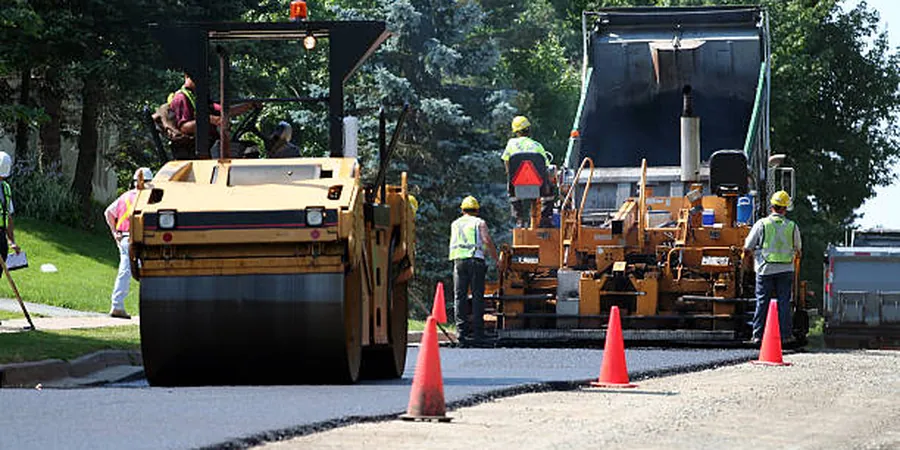
Designing a parking lot off Kenaston Boulevard poses a completely different challenge than a residential street in River Heights. The former often sits on deep, high-plasticity lacustrine clay, while the latter might intercept granular ridges left by glacial Lake Agassiz. In Winnipeg, flexible pavement design is never a copy-paste exercise. The city's infamous shrink-swell clays freeze to depths exceeding 2 meters in a typical winter, generating differential heave that shreds under-designed asphalt within two freeze-thaw cycles. A proper flexible pavement design anchors the structural section to site-specific subgrade strength, not just standard city details. Before finalizing the asphalt and base thicknesses, we often pair the investigation with an in-situ CBR assessment to capture the soaked bearing capacity of the native clay, and a grain-size analysis to confirm the suitability of locally sourced granular base course materials.
A Winnipeg flexible pavement design lives or dies by its subgrade drainage coefficient and the assumed depth of frost penetration under saturated conditions.
Methodology and scope
A recent project in the St. Boniface industrial area revealed saturated silty clay at 1.3 meters, a remnant of the Seine River floodplain. The initial owner's specification called for 100 mm of asphalt over 300 mm of crushed aggregate, but our subgrade evaluation under soaked conditions showed an effective CBR barely reaching 3%. This scenario forced a redesign to a thicker granular base and the inclusion of a geotextile separator to prevent fines migration. Our flexible pavement design methodology follows the AASHTO 1993 empirical approach, adapted for Winnipeg's climatic zone. We calculate the required Structural Number (SN) by layering the resilient modulus contributions from the asphalt layer, base, and sub-base, always applying a drainage coefficient that reflects spring-thaw saturation. Temperature is the silent variable here; asphalt stiffness in a July heatwave differs enormously from its brittle behavior in January. The process also integrates the subgrade's frost susceptibility classification, which dictates the minimum cover over the formation to prevent ice lens growth. Understanding these thermal extremes allows us to specify asphalt binder grades that resist both low-temperature cracking and summer rutting.
Local considerations
The transition from deep winter to spring thaw creates the most dangerous stress state for a flexible pavement in Winnipeg. As the frost leaves the ground from the top down, meltwater gets trapped between the impermeable frozen layer below and the saturated base above, temporarily reducing the subgrade to near-zero bearing capacity. This is why we design for the Reduced Subgrade Strength (RSS) period, not just the summer CBR. Ignoring frost effects leads to classic spring breakup: alligator cracking, deep rutting, and pothole epidemics that plague under-engineered commercial lots. Additionally, the differential heave of the Lake Agassiz clays can distort cross-falls, destroying drainage patterns. Our design explicitly calculates the allowable loss of serviceability over the design life, ensuring that the pavement maintains its structural integrity even as the clay swells and shrinks beneath it. We specify a non-frost-susceptible sub-base layer that acts as a capillary break, keeping the formation dry and stable during the critical thaw window.
Frequently asked questions
What is the typical cost range for a geotechnical investigation that supports flexible pavement design in Winnipeg?
For a commercial lot or roadway segment, the investigation, testing, and pavement design report generally fall between CA$2,100 and CA$6,540. The final figure depends on the number of boreholes, the extent of laboratory CBR testing, and whether we need to perform seasonal frost-depth analysis.
How does the Winnipeg climate specifically influence the asphalt binder selection?
We specify a Performance Grade (PG) based on the extreme lows and highs. Winnipeg often requires a low-temperature grade of -40°C to prevent transverse cracking, while the high-temperature grade must resist rutting during 30°C+ summer days. We typically start with PG 52-40 or PG 58-34 depending on traffic volume and speed.
Why is a soaked CBR test necessary instead of a standard Proctor?
Standard Proctor gives maximum dry density, but soaked CBR simulates the worst-case saturated condition during spring thaw. A Winnipeg clay can drop from a dry CBR of 10% to a soaked CBR of less than 2%. Designing with the dry value guarantees structural failure after the first winter.