← Home · Ground improvement

Vibrocompaction Design for Winnipeg’s Glacial Lake Clays

Together, we solve the challenges of tomorrow.

LEARN MORE →

A warehouse expansion near the Transcona rail yards hit refusal at 2.4 meters—loose sand over Lake Agassiz clay. The structural engineer needed 150 kPa bearing capacity but the SPT N‑values barely reached 8. We proposed a vibrocompaction design that increased relative density to 78% without over‑excavating the entire footprint. In a city built on 12,000‑year‑old lacustrine deposits, Winnipeg’s stratigraphy alternates between soft clay, silt, and pockets of outwash sand. Standard fill compaction often fails below 3 meters, especially where the Red River has reworked the upper layers. Our approach ties the test pit logs directly to the compaction grid, and when the sand fraction is too fine we cross‑check with CPT soundings to confirm the probe‑to‑grid spacing before mobilizing the vibroflot.

A well‑designed vibrocompaction grid can raise relative density from 45% to over 75% in two passes, eliminating deep foundations on marginal sand sites.

Methodology and scope

The vibrator we run on Winnipeg projects is a bottom‑feed electric unit with a 130 kW power pack, capable of treating depths down to 18 meters. The probe’s horizontal oscillation frequency is set between 30 and 50 Hz depending on the grain‑size curve, and water flushing is adjusted to 0.6 bar above the in‑situ pore pressure measured in the pre‑treatment piezometers. For each site we build a finite‑element grid in Plaxis 3D that simulates the radial densification front. The grid spacing—normally 2.1 to 3.0 meters on triangular pattern—is validated with an eight‑point sand cone density test program before the production pass. In the mixed soils south of Bishop Grandin Boulevard, where silt content exceeds 15%, we stage the compaction in two passes and monitor settlement with a real‑time data acquisition system that logs amperage, lift rate, and hold time every 0.5 seconds. This same methodology was used on a 4.2‑hectare logistics park near the CentrePort Canada development, where post‑treatment CPTs showed a 62% increase in tip resistance across the treated zone.
Vibrocompaction Design for Winnipeg’s Glacial Lake Clays
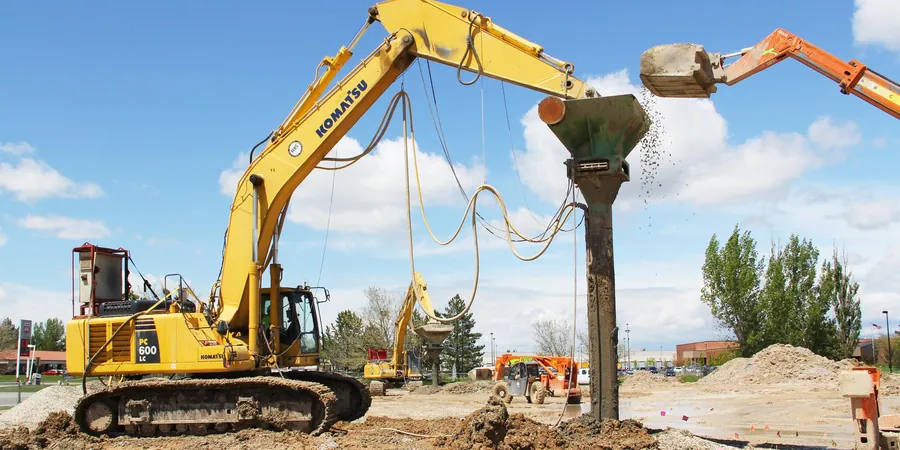
Technical reference image — Winnipeg

Local considerations

The mistake we see repeatedly on Winnipeg sites is specifying vibrocompaction on silty clay or plastic clay layers that cannot densify under vibration. When the fines content exceeds 15–18%, the probe simply remolds the soil without expelling pore water, leaving a softened zone that settles more than the untreated material. One developer in the St. Boniface industrial area learned this the hard way: a 1.2‑meter‑thick silt band trapped excess pressure, and post‑treatment differential settlement reached 70 mm within the first freeze‑thaw cycle. The fix required stone columns drilled through the silt to drain the excess pressure and transfer load to the underlying till. Our design protocol now mandates a full grain‑size analysis and Atterberg limits on every borehole before we commit to vibrocompaction. If the plasticity index exceeds 10, we switch the ground improvement strategy immediately. Winnipeg’s frost penetration—often 1.8 meters—adds another layer of risk because the upper crust of treated sand can heave if drainage is not directed to a perimeter collector.

Need a geotechnical assessment?

Reply within 24h.

Email: contact@geotechnicalengineering.vip

Technical parameters

ParameterTypical value
Typical treatment depth4 to 18 m below grade
Probe frequency range30–50 Hz (horizontal oscillation)
Grid patternTriangular, 2.1–3.0 m spacing
Pre‑treatment SPT N‑value (target)N₁₆₀ < 15
Post‑treatment relative density> 70% (ASTM D4254)
Design bearing capacity after treatment≥ 150 kPa (granular)
Water pressure during penetration0.4–0.8 bar above u₀
Applicable soil fines content< 15% passing #200 sieve

Associated technical services

01

Pre‑treatment Site Characterization

Review of existing boreholes, SPT logs, and lab data with supplemental CPTu soundings to map the target layer and identify exclusion zones.

02

Finite‑Element Densification Modeling

Plaxis 3D model of the probe‑to‑grid interaction, calibrated to site‑specific grain‑size curves and initial in‑situ density, producing predicted settlement contours.

03

Field Trial and QA‑QC Protocol

Eight‑point sand cone and CPT program on a 10 x 10 m trial panel to confirm energy input, spacing, and hold times before the production pass begins.

04

Post‑treatment Performance Report

Comparison of pre‑ and post‑treatment SPT or CPT results with statistical analysis, as‑built grid drawing, and a letter of conformance to the NBCC bearing criteria.

Applicable standards

ASTM D1586-18 Standard Test Method for Standard Penetration Test (SPT) — pre‑ and post‑treatment verification, ASTM D4254-16 Standard Test Methods for Minimum Index Density and Unit Weight of Soils — relative density target, NBCC Part 4 — foundation bearing pressure and settlement limits for treated ground

Frequently asked questions

What soil conditions in Winnipeg make vibrocompaction suitable versus unsuitable?

Vibrocompaction works best on clean to slightly silty sands with less than 15% passing the #200 sieve and a plasticity index below 10. The loose outwash sands found in parts of southwest Winnipeg and along the floodway are ideal candidates. It is not effective on the thick Lake Agassiz clays that dominate much of the city—those require stone columns, rigid inclusions, or surcharge with wick drains.

How long does a typical vibrocompaction design and field program take for a one‑acre commercial lot?

Desktop design and modeling take about 8 to 12 working days after receiving the geotechnical report. On site, a one‑acre treatment with a single vibroflot and a two‑pass pattern typically completes in 5 to 7 working days, including the trial panel and post‑treatment CPT verification.

What is the cost range for vibrocompaction design and QA‑QC on a medium‑size project in Winnipeg?

For a site between 0.5 and 2 acres, the engineering design and full‑time field QA‑QC monitoring generally falls between CA$1,880 and CA$7,820, depending on the number of CPT verification points and the complexity of the pre‑treatment data review.

Can vibrocompaction be used directly beneath shallow footings or only under floor slabs?

It can be used under both. We frequently design the treatment to extend 2 meters beyond the footing perimeter so the stress bulb stays within densified soil. For isolated pad footings we tighten the grid to 1.8‑meter spacing within the column footprint to achieve the 150‑kPa bearing target required by the NBCC.

What monitoring data does the engineer need during the production passes?

The vibrator’s onboard recorder must log depth, amperage, lift rate, and hold time for each probe point at a minimum 0.5‑second interval. We also install two standpipe piezometers at the edge of the treatment zone to track excess pore pressure dissipation, which guides the wait time between passes in silty ground.
Location and service area

We serve projects across Winnipeg and its metropolitan area.

View larger map