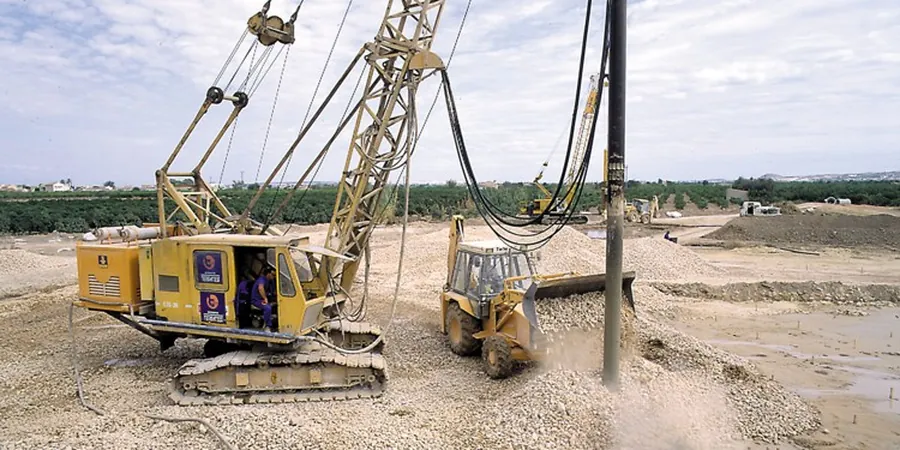
Winnipeg sits on up to 20 meters of soft, compressible glaciolacustrine clay deposited by Lake Agassiz. That lake disappeared 8,000 years ago, but its legacy shows up on every jobsite south of the Assiniboine River. We see it in the settlement data. Standard shallow footings rarely work here for structures heavier than three storeys without ground improvement. Stone column design offers a practical path forward. The columns densify the surrounding clay and create vertical drains that speed up consolidation. On a recent warehouse project near the Red River floodplain, we combined stone columns with a liquefaction assessment to confirm seismic performance under the NBCC 2020 hazard model. The approach cut predicted settlement by over 60 percent compared to untreated ground. No preloading. No deep piling across the whole footprint. That is the kind of outcome Winnipeg developers look for.
Winnipeg clay consolidates slowly. Stone columns cut settlement time in half by shortening the drainage path from meters to centimeters.
Frequently asked questions
What does stone column design cost for a typical Winnipeg commercial site?
Design fees for a typical commercial lot under 5,000 m² in Winnipeg range from CA$1,810 to CA$6,170 depending on the number of column zones and the load test scope. A full package with Priebe-method calculations, CAD layout, and load test supervision falls toward the upper end. Small sites with uniform soil and one column zone stay closer to the lower end.
How do you verify stone column performance in Winnipeg clay?
We run plate load tests on single columns and column groups, measuring settlement under staged loading up to 150% of design load. Modulus back-calculated from the load-settlement curve is compared against the design assumption. A second group test is required if modulus falls more than 15% below target. We also recommend CPT soundings between columns to confirm densification.
What aggregate specification do you use for Winnipeg projects?
Hard, durable, clean crushed stone with a gradation of 25 to 50 mm, meeting CSA A23.2-23A for freeze-thaw resistance. Fines content must stay below 5% by mass to maintain drainage function. We specify Los Angeles abrasion below 30% to prevent crushing during vibro-compaction.
How long after stone column installation can we start foundation work?
In Winnipeg clay, we recommend a minimum 72-hour rest period after the last column in a zone is installed. This lets excess pore pressure dissipate enough for load testing to reflect long-term stiffness. For sites with sand lenses, 48 hours may be sufficient. The exact window is confirmed with pore pressure monitoring during the load test phase.