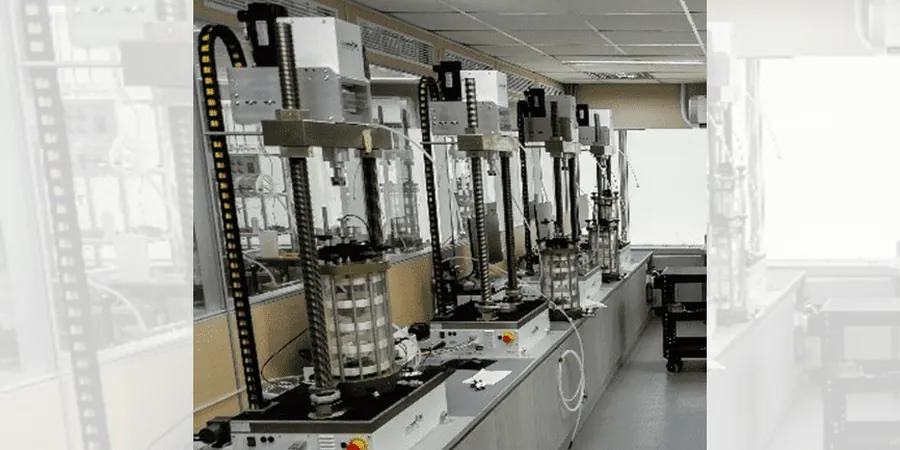
The high-plasticity Lake Agassiz clays beneath Winnipeg demand more than a simple shear vane reading. Seasonal moisture fluctuations in the Red River Valley generate substantial effective stress changes that only a consolidated-undrained triaxial test can capture accurately. Our lab runs triaxial programs under ASTM D4767 with pore pressure measurement, producing the drained and undrained strength envelopes engineers need for excavation support in the city’s swelling clay profile. For projects near the Assiniboine River, where soft alluvial silts complicate bearing capacity checks, we often pair triaxial data with CPT profiling to correlate lab strength with in-situ tip resistance and build a defensible geotechnical model.
Effective stress triaxial testing on Winnipeg’s lacustrine clays typically reveals φ’ angles of 20-25 degrees, with cohesion intercepts that reflect true overconsolidation from glacial loading.
Local considerations
The Winnipeg Formation—a stiff, preconsolidated glacial till underlying the city’s lacustrine clays—creates a misleading strength contrast. Shallow footings bearing on the upper clay may show adequate UU shear strength, yet long-term drained loading can trigger consolidation settlements if effective stress parameters are not properly measured. Triaxial tests that omit pore pressure measurement miss the low effective friction angles of these normally consolidated to lightly overconsolidated deposits. In the flood-prone zones south of Bishop Grandin Boulevard, where the water table sits within 2 meters of grade during spring, sample disturbance is another risk. Poor tube handling reduces undrained shear strength by 20-30%. Our technicians trim specimens immediately after extrusion and wrap them in plastic film for same-day setup, minimizing moisture loss and preserving the fabric of Winnipeg’s sensitive silty clays.
Frequently asked questions
How much does a triaxial test program cost in Winnipeg?
A standard CU triaxial with pore pressure measurement on one specimen runs between CA$2,350 and CA$3,640, depending on confining stress levels and whether you need a multistage setup. A full project program with three specimens typically falls within that range per test. We provide a fixed quote after reviewing the borehole depth and sample quality.
Why choose CU over UU triaxial for Winnipeg’s Lake Agassiz clays?
CU testing measures both drained and undrained strength, which matters in Winnipeg because the high-plasticity clays undergo significant consolidation under foundation loads. UU only gives total stress parameters, missing the effective friction angle needed for long-term settlement and slope stability analysis in the Red River Valley.
What sample quality is required for reliable triaxial results?
We need undisturbed Shelby tube samples with a recovery ratio above 90%. In Winnipeg’s sensitive silty clays, samples must be sealed immediately after extrusion and stored in a humidity-controlled room at 100% RH. Disturbed or desiccated specimens produce unconservative strength values and unreliable pore pressure response.