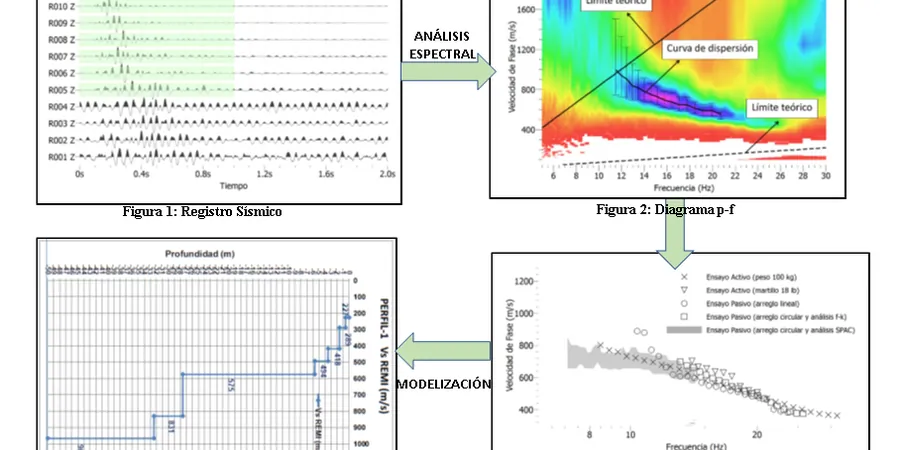
The geophone spread is laid out across the site — twenty-four 4.5 Hz vertical units, each spiked into the grass or gravel, connected by orange cable to a 24-channel seismograph mounted in the truck. In Winnipeg, we configure the array length based on the required depth of investigation, typically 46 to 92 metres for a full VS30 profile. The source is a 12-pound sledgehammer striking an aluminum plate at multiple offset distances. Each shot stacks three to five times to suppress ambient noise from nearby traffic on Pembina Highway or the rail yards in St. Boniface. The field work usually takes half a day, but the real value emerges during processing. Dispersion curves are extracted from the shot gathers, and a fundamental-mode inversion produces a 1D shear wave velocity profile tied directly to the seismic microzonation framework used in the city’s updated hazard maps. For deeper bedrock targets in the Assiniboine River valley, we sometimes pair the survey with seismic refraction to constrain the compressional-wave velocity structure and improve the inverted Vs model.
A VS30 of 180 m/s in Winnipeg’s Lake Agassiz clays can double the design spectral acceleration compared to a Class C assumption — the difference between a conventional footing and a piled foundation.
Methodology and scope
Winnipeg sits at an elevation of roughly 239 metres above sea level, but the engineering story is below ground. The city is founded on up to 20 metres of glaciolacustrine Lake Agassiz clays — high-plasticity, normally consolidated to lightly overconsolidated deposits that produce VS30 values commonly in the 150 to 250 m/s range. That places most central Winnipeg sites in NBCC Site Class D, though pockets of stiffer till or shallow limestone bedrock near the perimeter push some locations into Class C. The MASW method resolves these transitions without drilling, which matters in a city where winter frost can reach 2.4 metres depth and spring thaw turns the clay into a saturated sponge. We run the survey with a 2-metre receiver spacing as standard, but tighten to 1 metre when we need to capture a sharp impedance contrast at the clay-till interface. The dispersion curve is the fingerprint of the site — a clean fundamental mode with energy to 15 Hz tells us we have good coupling and can trust the inversion down to 30 metres. In our experience, the biggest quality-control issue in Winnipeg is not the clay itself but the cultural noise: buses on Portage Avenue, freight trains, and construction dewatering pumps generate low-frequency ground roll that can contaminate the record. We mitigate this with overnight surveys when the project schedule permits, and we always run a noise-monitoring record before committing to the production shots. The resulting VS30 value feeds directly into the seismic design parameters per NBCC 2020, and for critical infrastructure we also provide the full Vs profile for site-specific response analysis.
Local considerations
A mid-rise residential project on Corydon Avenue came to us after the structural engineer flagged a discrepancy: the geotechnical report assumed Site Class C based on a single SPT borehole, but the spread footings were designed for a four-storey wood-frame structure over 15 metres of soft clay. We ran a 46-metre MASW line in the back lane between two existing apartment blocks. The dispersion curve showed a fundamental-mode phase velocity of only 170 m/s at 10 Hz, and the inverted profile gave a VS30 of 185 m/s — solidly Class D, possibly verging on Class E under the NBCC 2020 site factors. That reclassification increased the short-period spectral acceleration by a factor of 1.3, which meant the footings had to be resized and the lateral system stiffened. The owner was frustrated by the delay, but the alternative was a building that didn’t meet code. In Winnipeg’s clay basin, assuming a higher site class without measured shear wave velocity data is the most common seismic design error we encounter. The cost of the MASW survey was less than the change-order that would have hit during construction if the deficiency had been caught later.
Applicable standards
NBCC 2020 — Division B, Article 4.1.8.4 (Site Classification for Seismic Response), ASTM D7400-17 — Standard Test Methods for Downhole Seismic Testing (adapted for surface-wave methods), CSA A23.3-19 — Design of Concrete Structures (seismic provisions referencing site class), NBC 2020 Structural Commentaries — Table 4.1.8.4.A (Site Classification), ASCE 7-22 — Minimum Design Loads and Associated Criteria for Buildings and Other Structures
Frequently asked questions
What is the difference between MASW and downhole seismic testing for VS30?
MASW is a surface-based method that uses an array of geophones and a sledgehammer source to generate and record surface waves. The dispersion curve is inverted to produce a 1D shear wave velocity profile without drilling a borehole. Downhole seismic testing requires a cased borehole and a downhole geophone receiver, with a surface source. MASW is generally faster and less expensive for VS30 determination, but downhole testing provides higher resolution at greater depths. In Winnipeg’s soft clays, we often use MASW as the primary method and reserve downhole testing for deep profiles where the surface-wave array length would be impractical.
How does the NBCC 2020 use VS30 for site classification?
The NBCC 2020 classifies sites from A (hard rock, VS30 > 1500 m/s) to E (soft soil, VS30 < 150 m/s) based on the average shear wave velocity in the top 30 metres. Most Winnipeg sites on Lake Agassiz clay fall into Class D (150-360 m/s) or sometimes Class E. The site class determines the short-period and long-period site coefficients that scale the design spectral accelerations. A lower VS30 means higher amplification, which increases seismic design forces on the structure. The code requires site classification by VS30 measurement for all buildings on soft soils where Class E is possible.
Can MASW be performed in winter when the ground is frozen in Winnipeg?
Yes, but with important caveats. Frozen ground increases the near-surface shear wave velocity significantly, which can bias the VS30 result upward if the frozen layer is included in the average. We typically schedule MASW surveys between May and November when the active layer is thawed. If a winter survey is unavoidable, we use a longer array and higher-frequency geophones to separate the frozen crust from the underlying unfrozen clay, and we apply a correction based on measured frost depth. The preferred approach is to wait for spring thaw conditions that reflect the long-term site behaviour.
How much does a MASW / VS30 survey cost in Winnipeg?
A standard active MASW survey for VS30 determination in Winnipeg typically ranges from CA$2,250 to CA$4,810 depending on the array length, number of survey lines, site access conditions, and whether the survey is combined with other geophysical or drilling services. The final cost includes field acquisition, data processing, dispersion analysis, 1D inversion, and a signed report with the Vs profile and NBCC site classification.
What quality control measures do you apply during MASW data acquisition?
We run a noise-monitoring record before production shots to identify and filter cultural noise sources. Each shot position is stacked three to five times, and we check shot gathers in real time for coherent surface-wave energy. The geophone spread is tested for coupling by tapping each unit and verifying the response on the seismograph. After acquisition, we examine the dispersion image for a clear fundamental mode — if the mode is discontinuous or multiple modes are interfering, we adjust the source offset and re-shoot. The final inversion is checked against any available borehole data to ensure the Vs profile is geologically reasonable for the Winnipeg clay basin.